
Reports
Digital Assets - Q2 in Review
Reports
Digital Assets - Q2 in Review


Q2 2026 was a quarter of two distinct phases. Despite the backdrop of the Iran war, higher oil prices and persistent inflation, equities pushed higher through April and May, with a narrow advance led by semiconductors and the wider AI-infrastructure complex carrying the major indices to fresh record highs. A sharp sell-off in the semiconductor complex midway through June briefly interrupted that advance, but the broad market had largely recovered by quarter-end, and the major indices still posted their strongest quarter since 2020. The more important signal, in our view, is not the quarterly return but what the mid-June scare revealed about how concentrated, and how vulnerable, the market’s leadership has become.
Our posture remains constructive but selective. The companies at the centre of the AI build-out are generating real and growing earnings, and the AI secular-growth story is not irrational exuberance given the real productivity impact the technology already has on the world economy. But positioning has become concentrated, and parts of the market appear to be assuming that the principal risks of the past months, most notably the Iran war, are largely behind them. An uptick in inflation, and the higher nominal interest rates that come with it, is the most clearly defined risk going into the third quarter. A Federal Reserve under new leadership and a new communication style, together with an oil market that remains sensitive to renewed escalation, add further uncertainty to the picture.
Against that backdrop, June brought significant political and institutional developments: a change of leadership in the United Kingdom that underscored how unsettled developed-market politics have become, and a Supreme Court ruling that, by contrast, reaffirmed the independence of the Federal Reserve at a sensitive moment. Digital assets, after a quiet and range-bound start to the quarter, turned heavier in June. Bitcoin failed once more at the $80,000 level that had capped it for months and slid toward $60,000 into quarter-end, while the digital-asset treasury companies that have defined this cycle saw their financing model begin to work in reverse.
We address each below. Across both equities and digital assets, the common thread is a market paying up for downside protection rather than reaching for the next leg higher, an appropriate stance, in our view, for the range of outcomes that lies ahead.
The headline returns capture both the strength and the scare. It was the best quarter for US equities since 2020, with the S&P 500 up roughly 14% and the Nasdaq Composite about 20%. But neither US index ended the quarter at its peak. The mid-June sell-off in the semiconductors that had led the markets in the first two months of the quarter knocked the Nasdaq Composite down roughly 3% lower on the month. The S&P 500 closed just shy of its early-June record. The Euro Stoxx 50 was the relative standout, gaining around 12% over the quarter and roughly 3% in June to a record of its own since its lack of technology exposure spared it the worst of the chip sell-off.
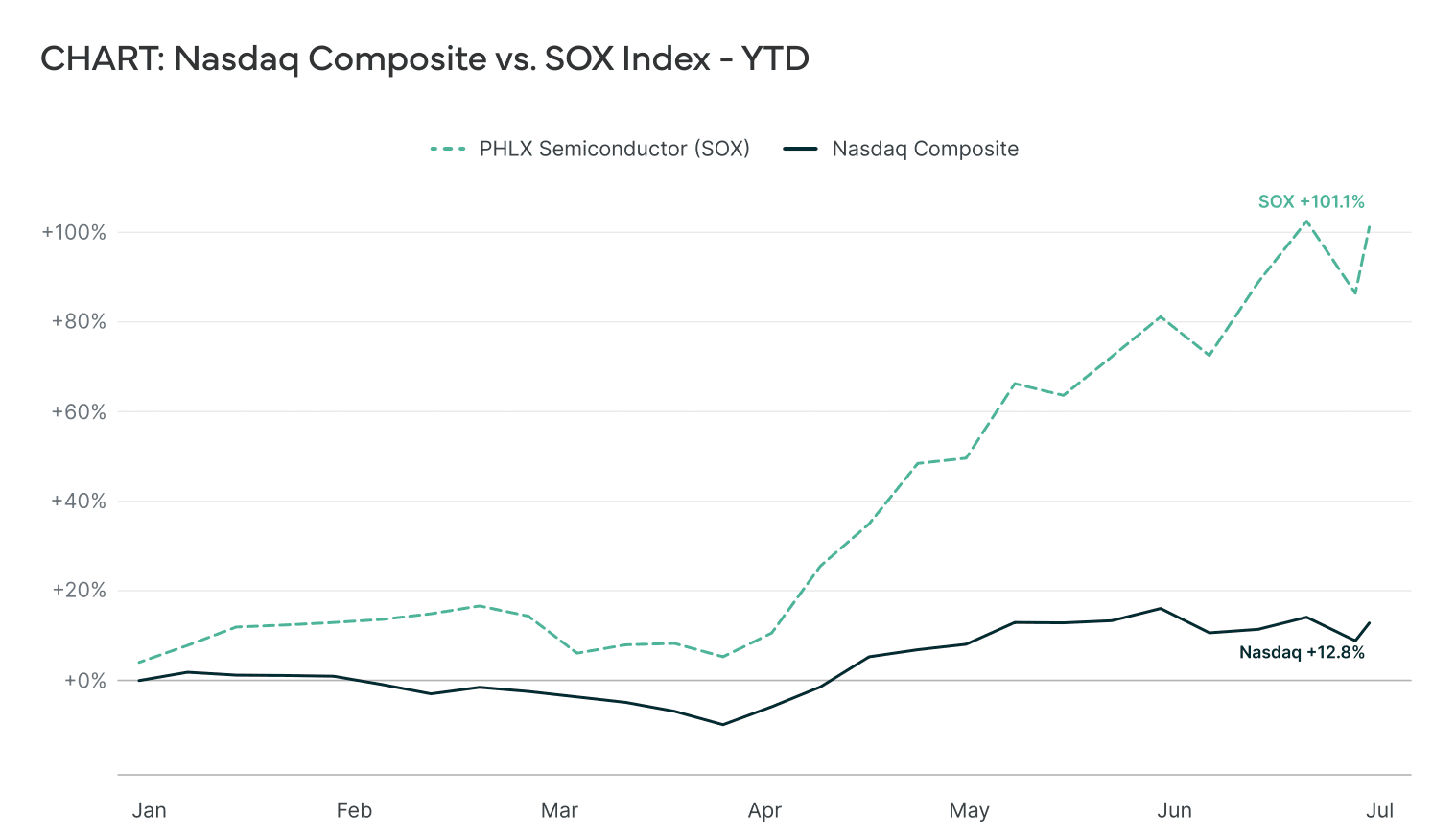
The defining feature of the quarter was the unusually narrow leadership that preceded the mid-June wobble. For one of the few times in this cycle, the Magnificent Seven were not the market’s engine. That role passed to the semiconductor and AI-infrastructure complex (the chipmakers, memory producers and data-centre supply chain), a narrower and more capital-expenditure-cyclical form of leadership than the mega-cap platforms of recent years. The numbers are striking. On our reading, a vast majority of the year’s best-performing US stocks are tied to semiconductors, AI or data centres, and the Philadelphia Semiconductor Index is up roughly 87-89% year-to-date against around 21% for the broader technology sector. The breadth data tell a related story. The equal-weight S&P 500, which had actually led the cap-weighted index earlier in the year, fell behind during the April and May mega-cap surge, before June’s pullback in the largest names swung the relationship back in its favour. The AI theme is not the pure speculation of the dotcom era. The revenues, the margins and the order books are real. But it leaves the market unusually exposed to a single theme, with little to lean on once that theme pauses, and a market carried by one secular story will sooner or later meet some fatigue. Micron offered a snapshot of both the strength and the fragility. Its fiscal third-quarter (May-quarter) revenue surged 346% to a record, led by a roughly sevenfold jump in data-centre sales, and the shares jumped on the news, yet even results of that magnitude could not insulate the stock from the broader sell-off that gripped the complex later in the month.
Source: FRED, Yahoo Finance
Semiconductor stocks far outran the broader tech sector measured by the Nasdaq Composite index
That fatigue duly showed itself in June, even if it proved short-lived. The sell-off came early and deepened around the middle of the month. On 4 and 5 June the Nasdaq fell 4.18% to 25,709, its weakest session since April 2025, after a stronger-than-expected May employment report lifted Treasury yields and revived talk of a rate hike rather than a cut. What began as a rate-driven repricing of long-duration technology valuations became more specific when Broadcom guided cautiously on AI-chip demand and declined to raise its long-range forecast, calling into question the extrapolation assumption around the AI data-centre build-out. Because leadership had been so concentrated, the weakness was too. At its low the AI-semiconductor complex had shed roughly $1.4 trillion in market value, with Nvidia alone accounting for over $300 billion, and the damage radiated through the supply chain and into Asia, where South Korea’s KOSPI fell about 10% in a single day on 23 June as Samsung Electronics and SK Hynix, central to the high-bandwidth-memory story, were caught in the move. Buyers returned in the final week, however, and the complex recouped much of the decline into quarter-end, a recovery that does little to resolve the underlying question of concentration.
Importantly, the repricing began before Kevin Warsh’s first meeting as Federal Reserve Chair on 17 June, driven by employment data and company-specific news rather than by the Fed. What the new Chair then did was reinforce a move already underway. The FOMC held rates steady but pared its statement of any easing bias, and Warsh set aside both formal forward guidance and the “dot plot” (declining, as the sole participant, to submit a rate projection) while criticising the 2021 and 2022 forecasts as having compounded the Fed’s earlier policy errors. He also flagged a year-end review of the Fed’s communications, from the number of press conferences to the projections themselves. The “regime change” rhetoric of his confirmation has, in short, begun to translate into institutional practice, in the form of a deliberately less predictable central bank which, all else equal, will tend to make for more volatile markets.
While equity markets sold off after the meeting and yields rose, Warsh’s first appearance reassured investors of the Fed’s political independence and allayed fears that the new Chair would bow to political pressure. It is worth highlighting, though, that Warsh has every incentive to talk a tough game, not only to demonstrate that the Fed remains independent of an administration that has been vocal in its preference for lower rates, but also to establish his own anti-inflation credibility. If the market finds him credible, expectations will do much of the tightening for him, particularly at the longer end of the curve, and he may not need to raise rates at all. If it does not, he may be forced to act to prove his credentials. Going into the third quarter, there is a real risk that the Fed hikes if labour markets tighten further or, more importantly, if a renewed escalation in the Middle East reopens the inflation channel.
The independence question gained a further dimension on 29 June, when the Supreme Court blocked the President’s attempt to remove Governor Lisa Cook. The Court ruled the dismissal procedurally void while leaving the larger question of for-cause removal for another day. It was a meaningful affirmation of the Fed’s independence at a sensitive moment, even if it settled less than the headlines implied.
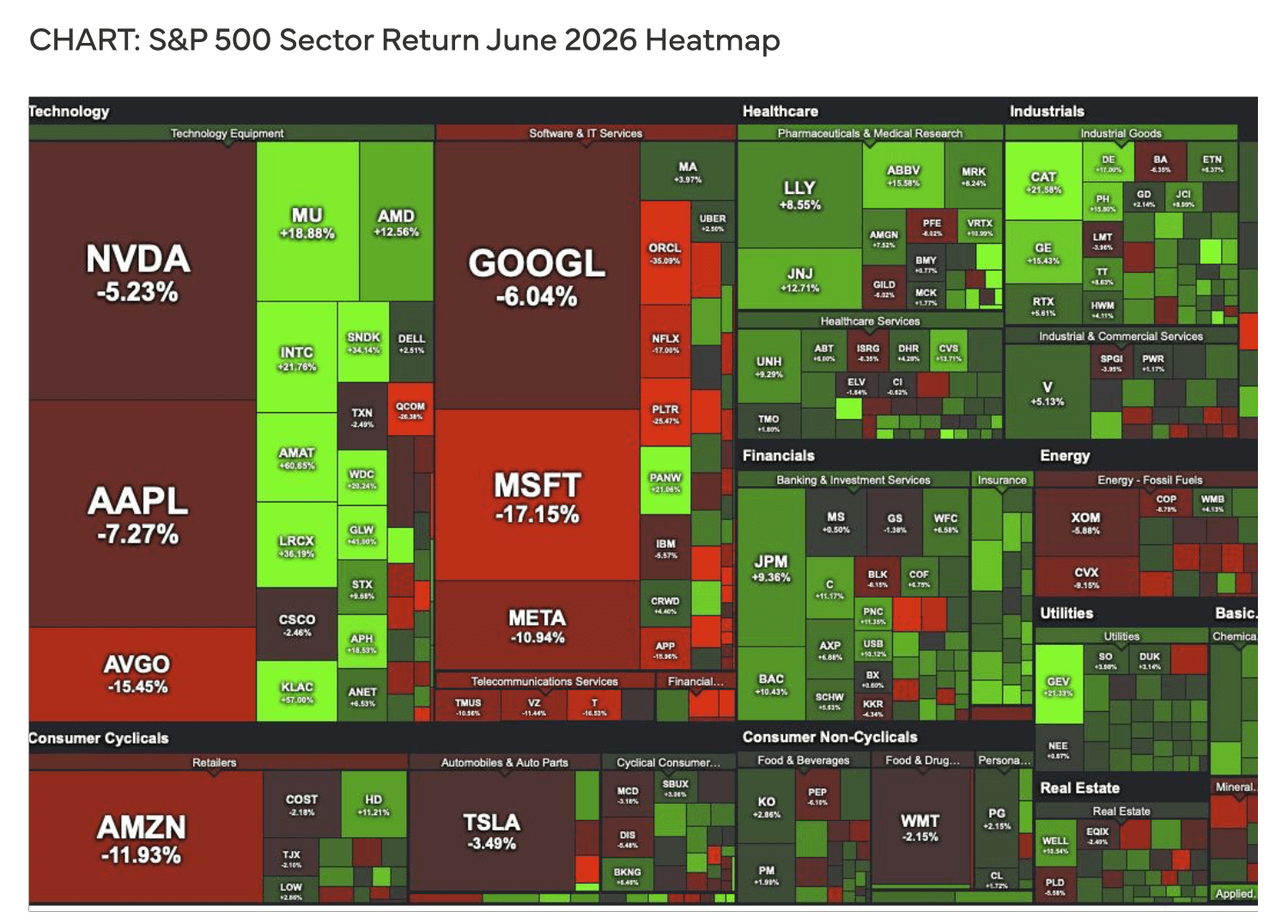
The ECB moved in the opposite policy direction, and the contrast is instructive. On 11 June the European Central Bank raised all three of its key rates by 25 basis points, taking the deposit rate to 2.25%, its first increase since September 2023 and a reversal of the eight cuts delivered between mid-2024 and mid-2025. President Lagarde rejected the “insurance hike” framing, described the decision as “robust across a range of scenarios”, and declined to pre-commit to a path. The ECB’s own projections show headline inflation averaging 3.0% this year before easing to 2.3% in 2027 and 2.0% in 2028. The divergence between US and European equities played out with a twist. The familiar composition story (the S&P 500 roughly a third technology by weight, against a European market dominated by old-economy industrials, pharmaceuticals and banks) left the Euro Stoxx lagging over the quarter as a whole. But in June it cut the other way, as the technology-heavy US fell harder mid-month and Europe’s lack of an AI engine proved a relative cushion rather than a drag.
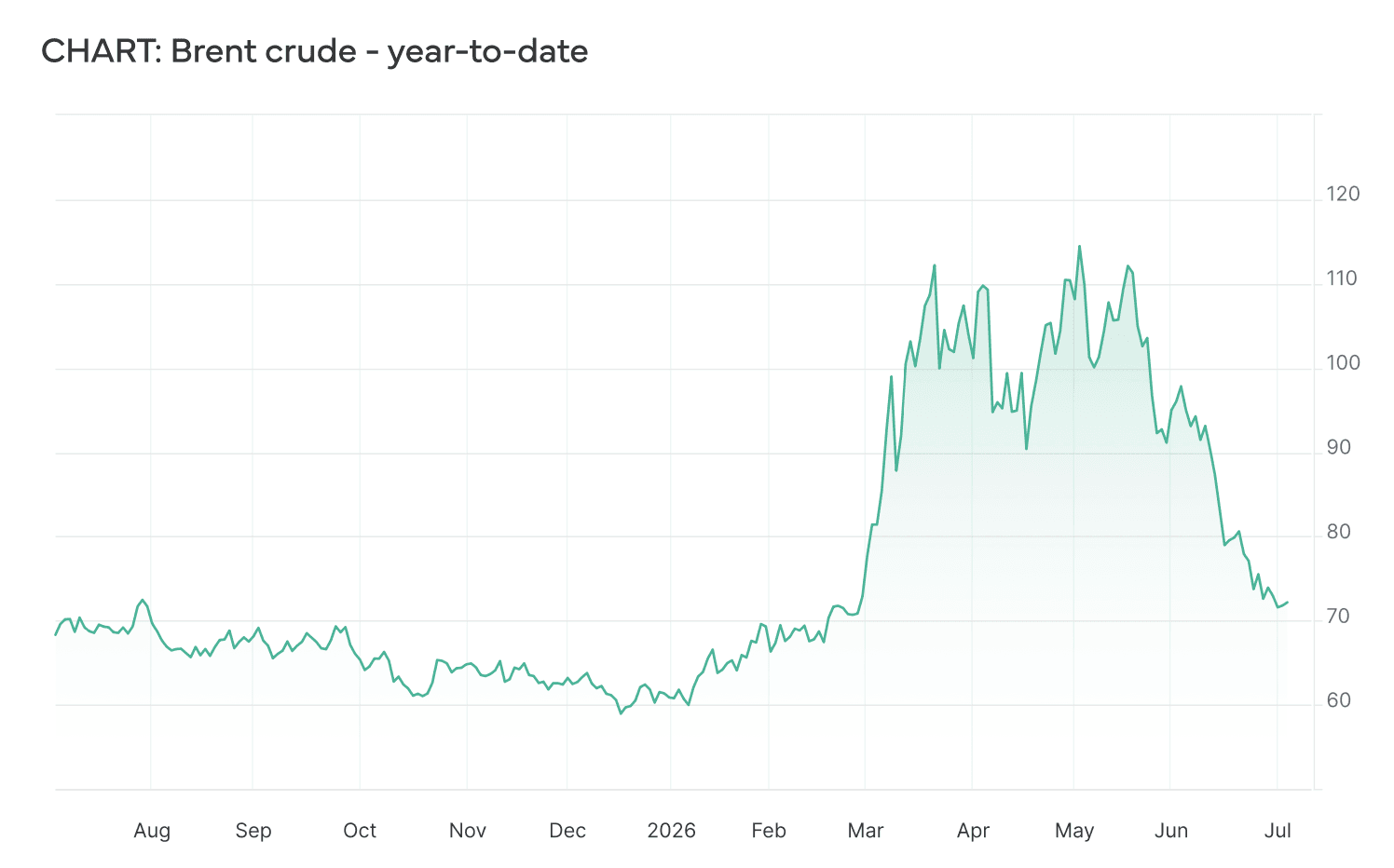
The oil market, which has driven the inflation story since the Iran war began, continued to normalise, arguably too smoothly. Brent, which opened the year near $62 and spiked above $114 in May, has retraced toward pre-war levels as US and Iranian negotiators have turned more constructive. With OPEC+ holding its production increases in abeyance and a post-crunch supply glut now emerging (the International Energy Agency puts the prospective oversupply at roughly two to four million barrels a day), the greater near-term risk may even be an undershoot. What is concerning is not the level but the complacency. The market is pricing the conflict as effectively settled, when the negotiations remain fragile and Israel, with unfinished business in Lebanon and limited appetite for a durable deal, retains both the capacity and the incentive to reopen it. A re-escalation would feed straight back into the inflation and policy questions above.
Two other corners of the market are worth noting. Gold, which disappointed as a war hedge earlier in the conflict, has found firmer footing for a different reason. Concerns about Federal Reserve independence, crystallised by the Cook case, have lent it a renewed bid even as real rates have risen. It is behaving as a hedge against institutional and currency debasement rather than against geopolitical shock, which is closer to its traditional role. Private credit, meanwhile, remains a slow-burning concern. The redemption pressure that built earlier in the year across the large semi-liquid vehicles has neither resolved nor sharply worsened, but the structural issues are unchanged: valuation opacity, the mismatch between illiquid assets and quarterly redemption windows, and loan books concentrated in precisely the software and AI-adjacent sectors most exposed to the disruption that the equity market began to price over June.
The quarter’s other notable market event was the listing of SpaceX. The offering was the largest in history, raising $75 billion ($86 billion including the greenshoe) at a valuation around $1.75 trillion, comfortably eclipsing Saudi Aramco’s previous record, and it debuted strongly, helped by a pre-IPO reshuffling of liquidity that drew a wave of retail participation. The structure of the deal warrants a careful eye. The shares trade at roughly a hundred times revenue, the public float is tiny at approximately 4.25%, and the dual-class arrangement, under which insiders’ Class B shares carry ten votes each and leave the founder with approximately 82% of the vote after listing, gives outside shareholders very little say. Most striking is the mechanism of index entry. Nasdaq changed its inclusion rules, effective 1 May, so that a company of SpaceX’s size qualifies within fifteen trading days rather than the usual quarter, with its weight then scaled up over time, compelling passive funds and benchmarked institutions to buy a thinly floated stock regardless of price or view. A combination of an extreme valuation, a minimal float and a marked erosion of shareholder rights is not, on its own, a market top. But it is the kind of configuration that has tended to appear nearer the end of cycles than the beginning.
In the UK, Keir Starmer announced his resignation on 22 June, having lost the confidence of his parliamentary party amid the surge of Reform UK and a punishing set of May council results. With Andy Burnham emerging as effectively the only candidate to succeed him, his position reinforced by a commanding by-election win, he is widely expected to become the country’s next prime minister, its seventh in a decade. The market reaction was telling, and counter-intuitive. Gilt yields, which had spiked to multi-decade highs on the local-election results, actually eased once Starmer’s departure became clear, as Burnham committed to the existing fiscal rules and as oil prices fell. A bond market that treats a prime minister’s resignation as a source of relief is not a stable one, and it is the underlying fragility, not the temporary reprieve, that we think matters.
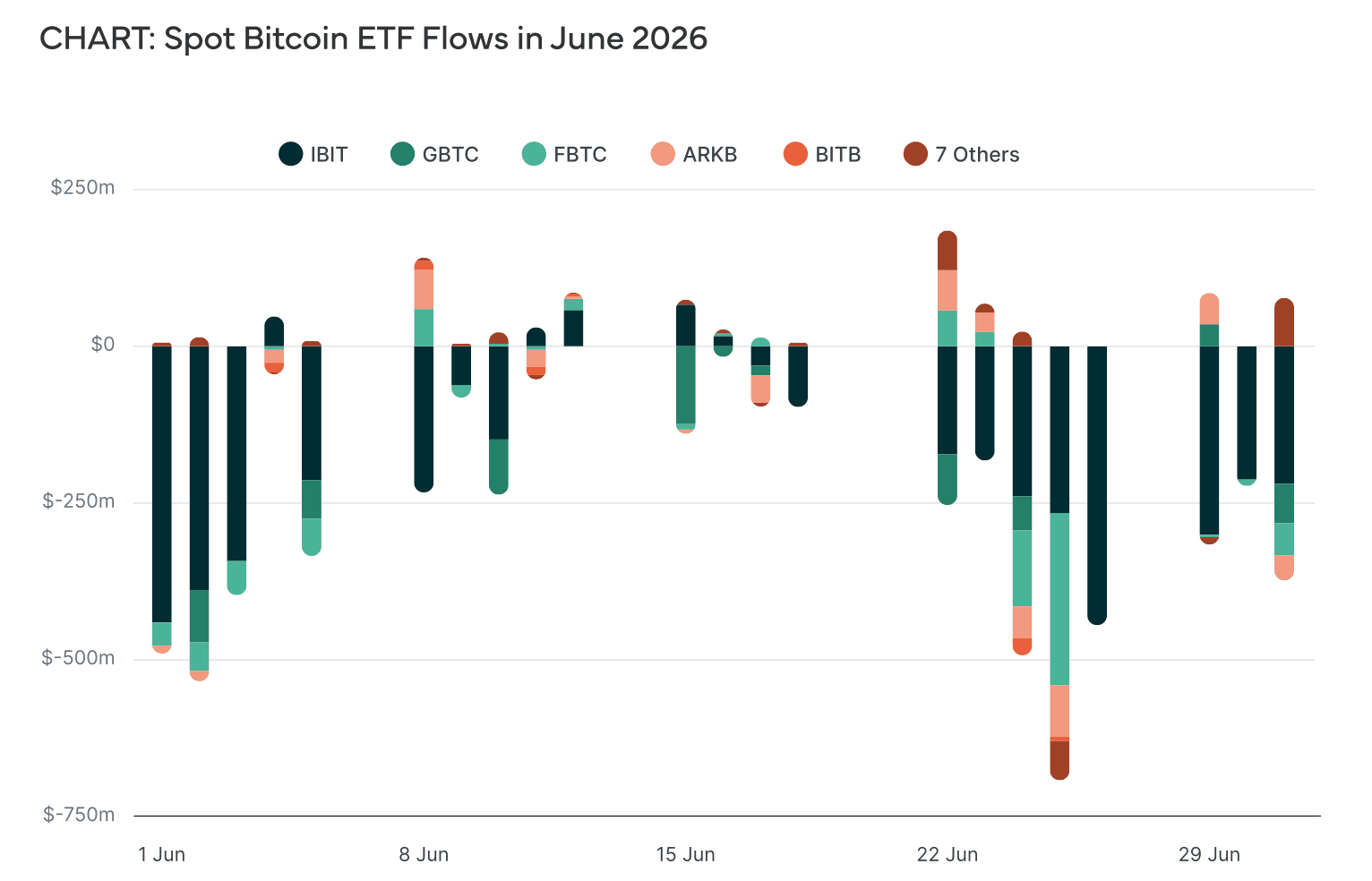
Digital-asset markets spent most of the quarter quiet and range-bound before turning heavier in June. After improving into May, when Bitcoin’s 50-day moving average flattened and eased one of the main technical objections to the bullish case, the market failed once again at the $80,000 ceiling that had capped it for months, lost the $72,000 to $75,000 support zone, and slid toward its 200-week moving average around $62,500, briefly trading below $60,000 into quarter-end as its 200-day average rolled over. The drivers were familiar and largely mechanical: redemptions from the spot ETFs, a broad macro risk-off, and leveraged liquidations, rather than any fundamental deterioration in the asset class.
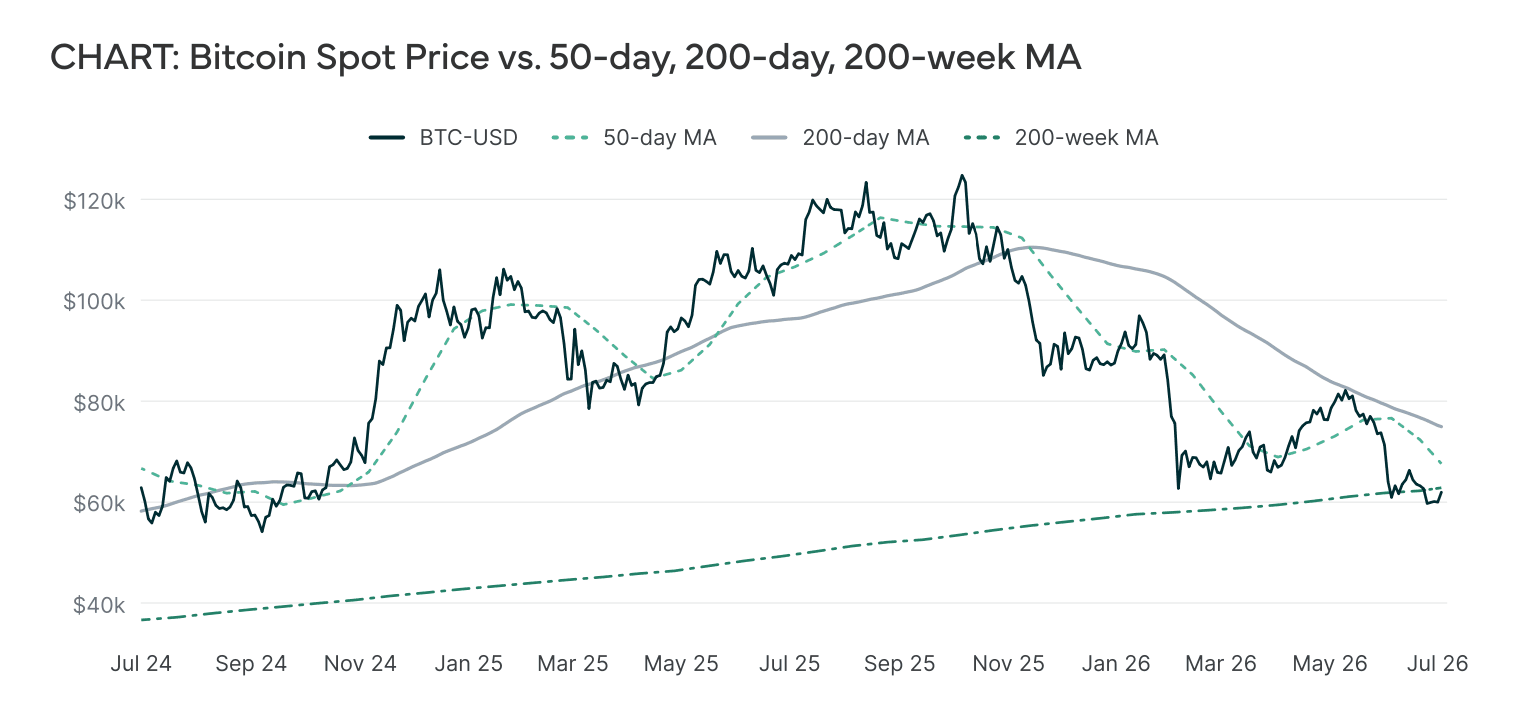
Source: Yahoo Finance
Bitcoin broke below its 50-, 200-day and 200-week averages in Q2
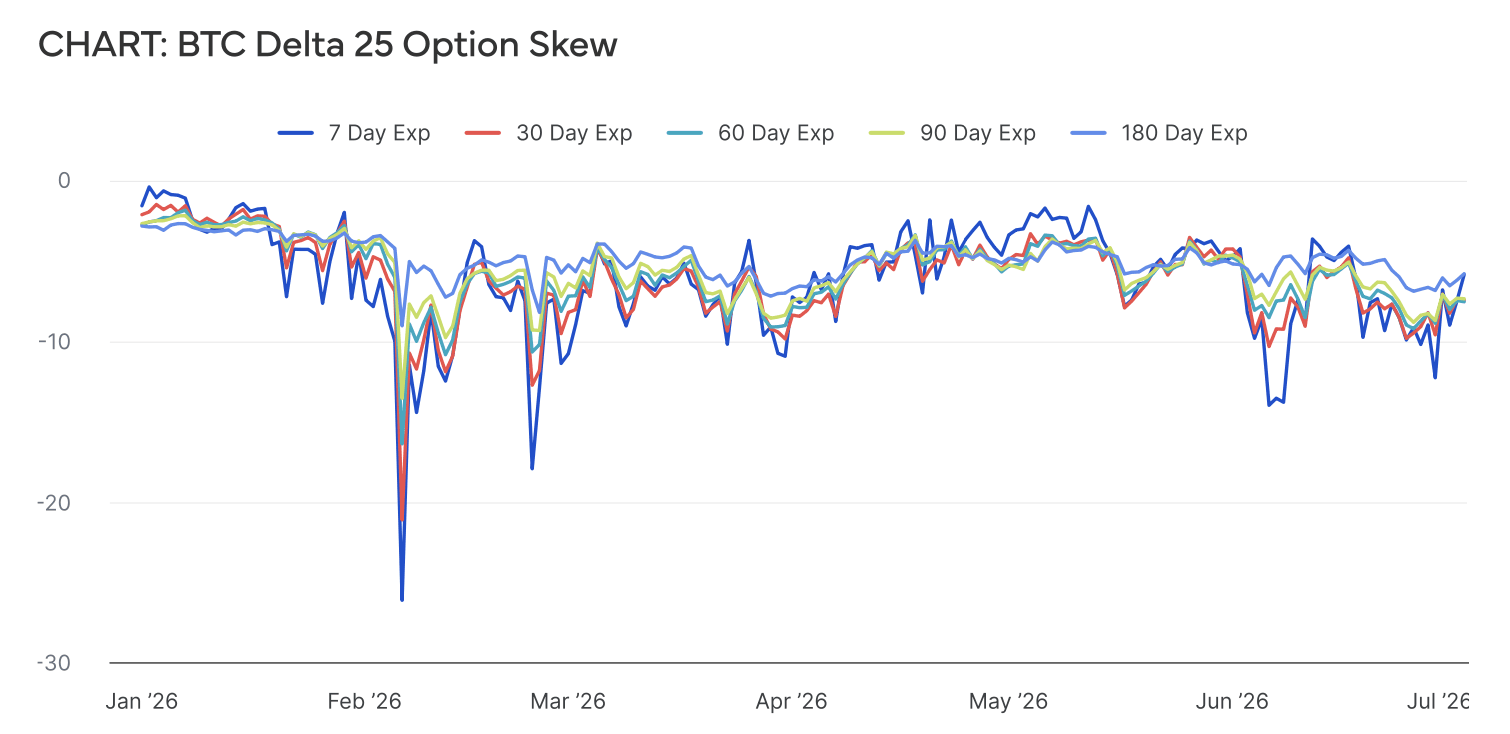
The volatility picture captured the mood. Equity volatility, as measured by the VIX, woke up in June, yet crypto’s implied-volatility index stayed compressed, in what one desk aptly called an illusion of calm. Beneath that calm, realised volatility was high enough to keep short-dated implied volatility rich, particularly for downside protection. Traders sold upside through call overwriting to fund out-of-the-money puts, and the put skew widened, alongside flat open interest, pointing to structural hedging rather than directional conviction. That posture mirrors the equity market, where the cost of tail protection stayed elevated relative to headline volatility. On both sides, participants are paying for protection rather than positioning for a rally.
The most consequential development, however, was structural, and it concerns the digital-asset treasury companies that have become such a prominent feature of this cycle. The model is elegant on the way up. When such a company trades above the value of the crypto it holds, it can issue stock at a premium and buy more, raising the amount of crypto backing each share, a self-reinforcing flywheel that also supplies a steady source of marginal demand. That logic runs in reverse once the shares fall below the value of the underlying holdings, as many did this quarter. Strategy, the largest, traded at around 0.76 times the value of its holdings and briefly slipped below parity on an enterprise basis in late June. At that point the accretive issuance that justified the model stops, and the financing edge disappears.
The trigger was symbolic rather than large. Having maintained for years that the company would never sell, Michael Saylor signalled on the early-May earnings call that Strategy might part with a small amount of bitcoin to fund its preferred dividends, and in late May it did so, selling 32 bitcoin for roughly $2.5 million, its first disposal since 2022. The sum was immaterial; the signal was not. It cracked one of the market’s load-bearing narratives, and the reaction was out of all proportion to the trade: crypto fell around 3% on the disclosure, some $160 billion of market value evaporated within the week, and the US ETFs recorded a record outflow streak of roughly $4 billion as investors began to anticipate a negative feedback loop.
The obligations that prompted the sale have not gone away, and the mechanics are worth spelling out. Strategy funds itself in part through several series of perpetual preferred stock that pay fixed cash dividends. Unlike the common dividend, those payments are effectively non-discretionary: missing them would impair the company’s standing with preferred holders and choke off the continued market access on which the whole model depends. The difficulty is that the equity issuance that normally services them only works while the shares trade above the value of the holdings. Once the stock falls below that level, raising fresh equity becomes dilutive rather than accretive, and the company’s modest software cash flows come nowhere near covering roughly $1.5 billion a year in preferred dividends against about $1.4 billion of cash, close to ten months of runway. That left two levers: sell some bitcoin, or issue still more preferred at a higher cost. The capital framework Strategy unveiled at quarter-end used both, raising the coupon on its STRC preferred to 12% and creating the authority to sell up to roughly $1.25 billion of bitcoin if needed. That authorisation is an enabling measure rather than a stated intention to sell: it gives the company the option to act, but as of quarter-end it had not done so.
The reason this matters beyond a single balance sheet is scale. Strategy holds roughly 847,000 bitcoin, around 4-4.5% of all the bitcoin in circulation today. Should the largest and most leveraged holder become a price-insensitive seller in order to defend its preferred stock, that selling would weigh on bitcoin, which would lower the value of its holdings, which would in turn pressure the equity and raise its cost of capital, a reflexive loop more reminiscent of a leverage-driven unwind. That even debt-free treasury companies saw their securities repriced suggests the market is reassessing the model itself rather than any individual firm. We would stress that this is a tail risk to monitor into the third quarter, not our central case, and certainly not a verdict that the asset class has peaked. But it is the clearest example this quarter of how financial engineering built for a rising market can amplify a falling one.
Regulation, by contrast, moved in a constructive direction throughout the quarter, even as prices fell. In the United States, the SEC proposed removing the long-standing “trade-through” rule and signalled a tailored exemption for decentralised finance. The significance is easy to miss in the technical language. Current rules require an order to be routed to whichever venue displays the best price at that instant, a standard that tokenised equities trading around the clock on decentralised platforms cannot realistically meet. Replacing it with a broader best-execution obligation would remove what one prominent researcher called among the largest structural barriers to on-chain equities, with the full effect expected in early 2027 and pilot exemptions sooner. The Senate separately passed a bill prohibiting a US central bank digital currency, and the CLARITY Act continued to advance. In the EU, the MiCA regime reached its hard implementation deadline on 1 July, with the effective collapse of Binance’s pan-European licence application (the exchange withdrew its filing in Greece before a formal ruling was issued) taken as a sign that the framework has genuine teeth. In the UK, the Bank of England softened its draft stablecoin rules, replacing individual holding caps with a £40 billion per-issuer issuance limit and allowing a larger share of reserves to be held in short-dated government bonds, even as a requirement to keep 30% in non-interest-bearing central-bank deposits remains a competitive constraint. The connective thread is that tokenisation is institutionalising independently of the crypto price cycle: Bernstein estimates the tokenised real-world-asset market has grown more than 40% this year, to above $51 billion, even as the broader crypto market fell, with tokenised equities up around 130%.
The central question entering the third quarter is not whether equities are cheap or expensive but how wide the range of outcomes remains, and whether the mid-June scare was a foretaste of a broader downturn or merely a healthy correction in a market that had gotten ahead of itself. The earnings beneath the AI trade are real, and we do not read June as the beginning of a broad unwind. But the speed with which a concentrated market wobbled, and then recovered, showed how sharply narrow leadership can cut in both directions, and several of the quarter’s threads remain unresolved: a deliberately less predictable Fed whose credibility is still being tested, an oil market pricing a settlement that has not been reached, and a digital-asset treasury complex whose financing model has begun to work in reverse. Persistent inflation, and the higher rates that accompany it, remain the clearest near-term risk.
Going into the second half of the year, the variables worth watching are well defined: whether the Middle East negotiations hold or Israel reopens the conflict, how Warsh manages the gap between his hawkish signalling and an economy that may not require it, whether the semiconductor complex stabilises or its June weakness broadens, and how smoothly the market absorbs both the SpaceX listing and any forced selling from the bitcoin treasuries.
Disclaimer
Investment advisory and asset management services are provided by Lionsoul Global Advisors Ltd. (“Lionsoul Global Advisors”), an investment adviser organized in the British Virgin Islands and relying on the safe harbor under the Investment Business (Approved Managers) Regulations, Revised Edition, 2020, pending approval by the BVI Financial Services Commission for approval as an "Approved Manager." Lionsoul Global Advisors does not and cannot provide any services to U.S or U.S.-based clients.
This should just replace the below language in the current disclaimer:
Investment advisory and asset management services are provided by Lionsoul Global Advisors LLC
(“Lionsoul Global Advisors”), an investment adviser registered with the Texas State Securities Board
(CRD #: 324883)