
Reports
Digital Assets - July in Review
Reports
Digital Assets - July in Review


July was the month in which the principal risks flagged in our second-quarter letter stopped being hypothetical. The US–Iran ceasefire collapsed in mid-July, and by the 23rd Brent had traded through $100 for the first time since May after Houthi attacks on Saudi tankers opened a second chokepoint in the Red Sea. The semiconductor unwind that had briefly gripped markets in June returned with far greater force, this time centred on Korea, where the KOSPI suffered its worst month on record before staging a strong recovery in the final session. And Strategy, the largest of the bitcoin treasury companies, made the largest bitcoin disposal in its history to fund its preferred dividends, the very scenario the market had spent June dreading. What matters, in our view, is what happened next: the system bent, but it did not break. US equities ended the month within reach of their highs, Korea staged a record rebound in the final session, and bitcoin absorbed the most closely watched forced seller in the asset class without breaking down. Digital assets, having de-rated through much of the year while equities made records, were the best-performing major asset class of the month.
Hanging over all of this is a Federal Reserve that has now abolished forward guidance in practice as well as in rhetoric. The July FOMC held rates against three hawkish dissents, long-term Treasury yields rose to their highest since 2007 even as policy stood still, and the curve steepened sharply. A central bank that insists it “will not waver” while declining either to act or to explain is asking markets to do its tightening for it. Whether that proposition holds is, we think, the single biggest variable for the second half, and nowhere more so than for the AI trade that still carries the equity market.
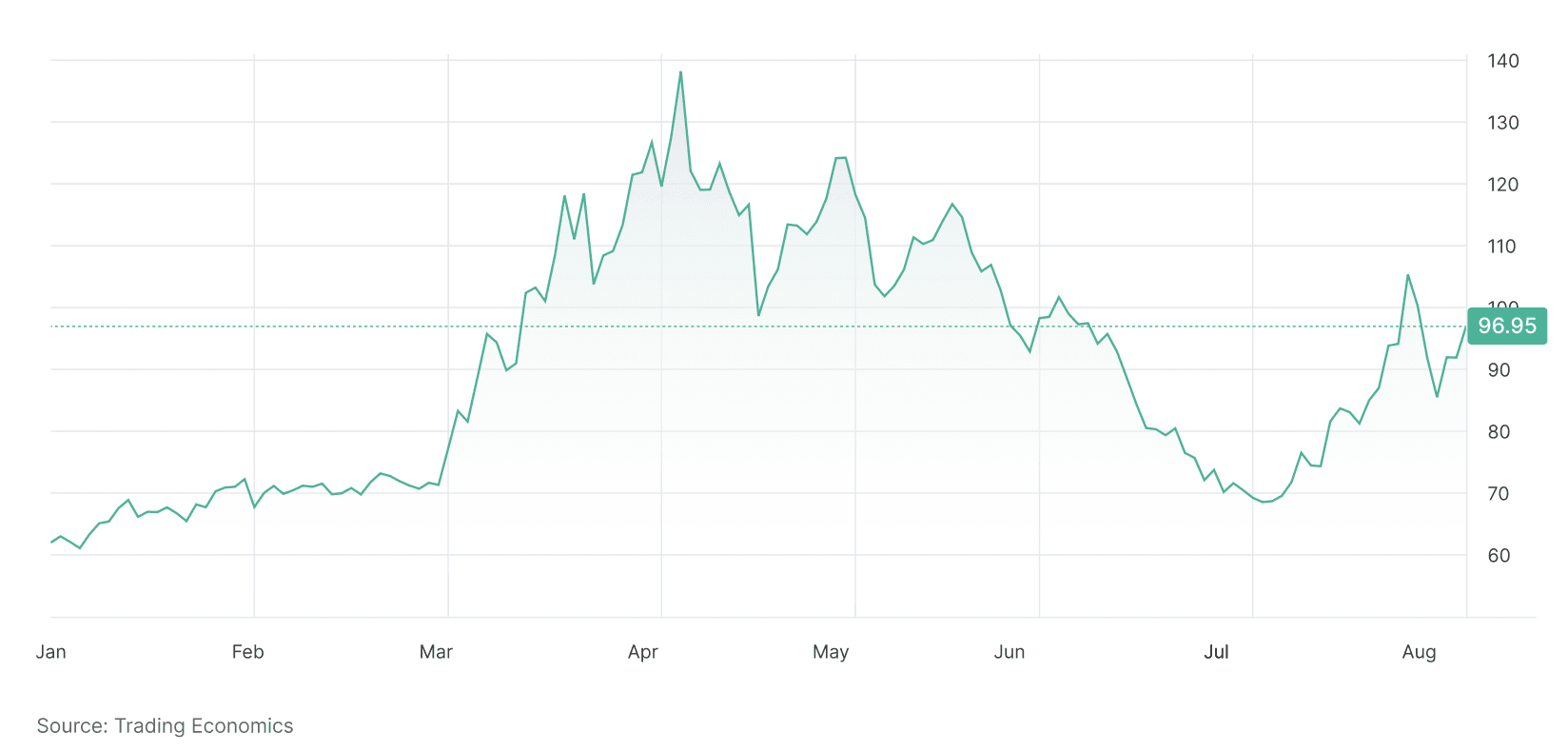
The ceasefire did not survive the month. Washington resumed what it described as limited military action in mid-July, and US strikes continued for thirteen consecutive nights against Iranian coastal-defence, missile and maritime targets. Iranian missiles struck two UAE tankers in Omani territorial waters, and Tehran continued to insist on control of the Strait of Hormuz as the price of any settlement. The escalation that moved markets came on 23 July, when Houthi attacks on two Saudi tankers near the Bab el-Mandeb strait threatened the Red Sea route through which Saudi Arabia had been re-routing crude via its East–West pipeline, in effect opening a second chokepoint. Brent rose roughly 7% that day to close for the first time above $100 since late May. Prices eased back toward $90 into month-end as regional mediators tabled a ten-day ceasefire proposal, but the round trip made the point we pressed last quarter: the market had been pricing a settlement that had not been reached. Energy Consultants such as the EIA now sees Brent holding near $100 into year-end if disruptions persist.
Source: Trading Economics
Brent broke above $100 on 23 July, its first time above that level since late May, after Houthi attacks on Saudi tankers opened a second chokepoint in the Red Sea, before easing into month-end on ceasefire-proposal headlines.
The inflation data, meanwhile, offered a look in the rear-view mirror. June CPI, released on 14 July, showed headline prices falling 0.4% on the month, the largest monthly decline since April 2020, taking the annual rate to 3.5% against expectations of 3.8%; core inflation was flat on the month at 2.6% year-on-year. The entire improvement was energy: the energy index fell 5.7%, its biggest monthly drop since April 2020, as June’s oil retreat fed through.But , it seems like nobody at the Federal Reserve was cheering as July’s renewed oil spike means the next print will mechanically reverse much of the progress, and the second-round effects of $100 oil will find their way into core inflation over time.
Against that backdrop the July FOMC, the second full meeting under Chair Warsh, held the funds rate at 3.50–3.75% on a 9–3 vote, with the dissents, from Cleveland’s Beth Hammack, Minneapolis’s Neel Kashkari and Dallas’s Lorie Logan, all in favour of a hike. The statement was shorter still than June’s, forward guidance is now gone in substance as well as in style, and Warsh used the press conference to insist that the Fed “will not waver” on inflation and that there is “no soft inflation target”. The market’s reaction was more instructive than the decision. The two-year yield fell after the expected hold was delivered , while thirty-year yields rose to around 5.3%, their highest since before the 2008 financial crisis, with the ten-year near 4.75%, an eighteen-month high, and mortgage rates back above 7.5%, a pronounced steepening that is hard to read as anything other than the long end beginning to question the Fed’s resolve and to price higher long-term inflation. Futures now imply roughly a two-thirds chance of a quarter-point hike at the next meeting.
There is, from the outside, an obvious tension in the Fed’s position. A central bank that declares two percent to mean two percent, and inflation to be “a choice”, has now twice declined to raise rates with core inflation moving sideways close to 3% for months and the target missed continuously since early 2021. This is no longer purely a war-and-oil story: the risk is that inflation expectations become unanchored while the Fed explains why it is waiting. Warsh’s evident preference, consistent with the framework we described last quarter, is for the market to do the tightening for him; if his hawkish rhetoric is believed, the long end tightens financial conditions without a single policy move. July showed both the power and the fragility of that approach. The long end did indeed tighten, but for the wrong reason, on doubt rather than belief, and the openly communicated reliance on markets to restrain inflation has begun to cost the new Chair credibility. The abolition of forward guidance compounds the problem: with no dot plot, no guidance and fewer communications, investors cannot reconstruct the Fed’s reaction function, and, as we have argued in previous editions of this publication, a deliberately less predictable central bank makes, all else equal, for more volatile markets. If the long end continues to push, the Fed may find its hand forced at exactly the moment it had hoped words would suffice.
Two further developments underline how central the long end has become. The first is fiscal. The Congressional Budget Office projects a $1.9 trillion federal deficit for fiscal 2026 and debt held by the public of $32.1 trillion, or 101% of GDP. With no meaningful spending restraint in prospect, the market is demanding progressively higher compensation to hold long-dated government debt, and auctions are clearing at correspondingly higher levels. The long end, in other words, is no longer pricing only inflation; it is pricing excessive supply.
The second development came at month-end, when the United States and Japan conducted their first joint yen intervention in three decades, the Treasury and the Federal Reserve buying yen against euros and pushing dollar-yen from around 163 to 158. The stated context is Japanese: a weak yen makes dollar-priced energy imports punishing in the middle of an oil shock, and Japan – the larger holder of US Treasuries – had already spent a record sum of reserves defending the currency, in large part by selling US Treasuries. That mechanism is precisely what matters for Washington, since Japanese Treasury sales push US long-end yields higher at the moment the American authorities most want them contained, and a joint intervention is therefore best read as a statement of what the US now cares about most: containing long-duration rates. Whether two governments visibly leaning one way can hold a currency level against a market that knows their position is an open question, and a stronger yen cuts both ways, since it forces the unwinding of yen-funded carry trades, a mechanically risk-negative flow. Both threads, fiscal supply and the yen, now sit alongside the Fed itself at the centre of the rates story.
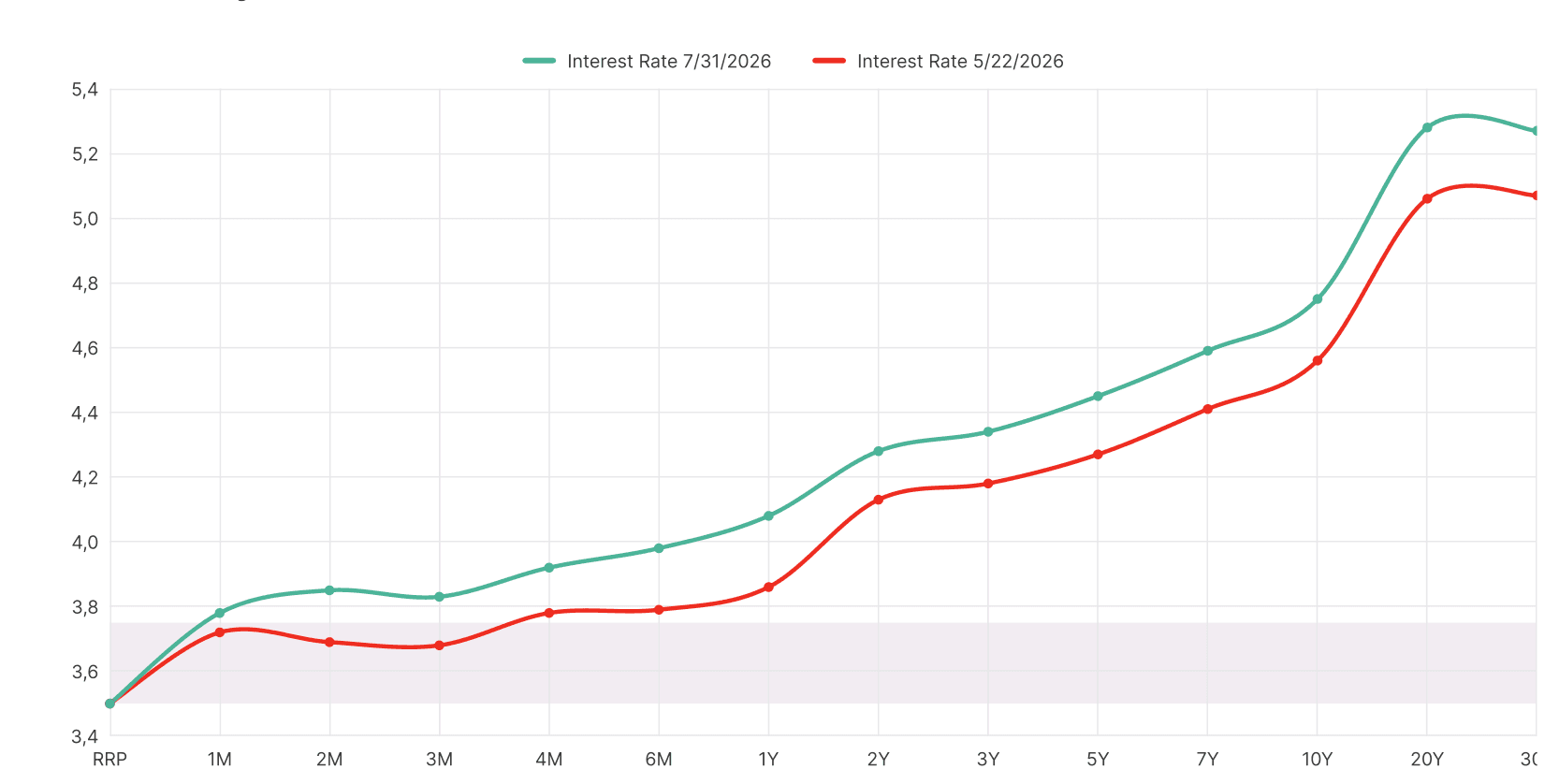
The curve steepened sharply after the July FOMC: the two-year fell as a priced hike failed to materialise, while thirty-year borrowing costs reached their highest level since 2007. Since Warsh took office on May 22nd, yields across the curve have risen.
The United Kingdom offered a preview of what bond-market discipline looks like when credibility is already spent. Andy Burnham became prime minister on 20 July, the seventh prime minister since 2016, and appointed John Healey as chancellor. Within hours of Burnham suggesting he would seek “any flexibility” within the fiscal rules, gilts sold off, pushing the ten-year yield through 5%, the highest in the G7 and its longest stretch above that level since 2008, with the thirty-year near 5.75%. The episode makes a broader point about the room for manoeuvre available to the new government: there is very little. Every signal of fiscal loosening is repriced within hours, debt-service costs rise mechanically with each sell-off, and the chancellor’s arithmetic deteriorates before a single policy has been enacted. A government that came to power promising change is discovering that the bond market, not the Labour manifesto, sets the constraint.
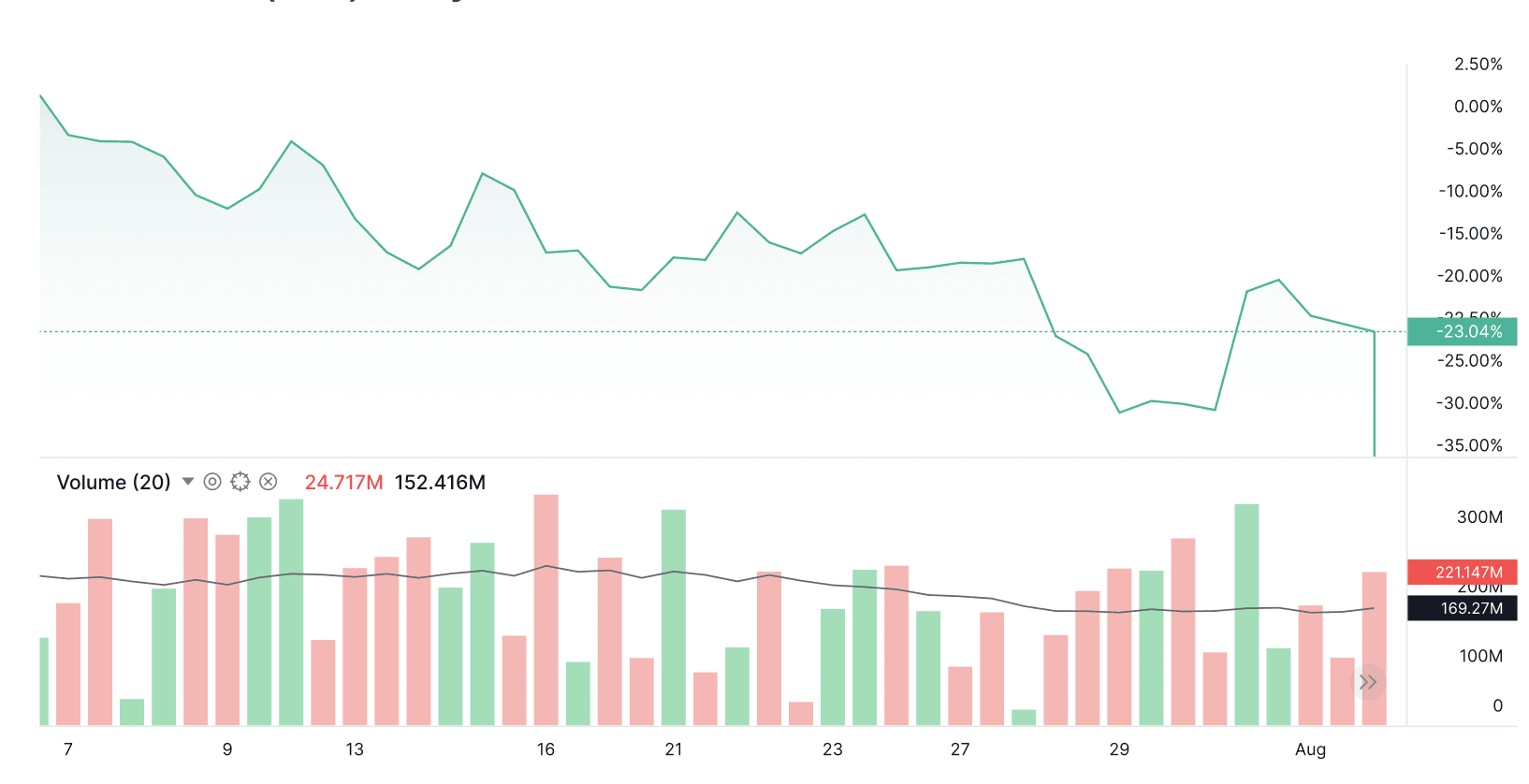
The month’s defining equity event took place in Asia. The KOSPI fell roughly 23% in July, its worst month on record, triggering seven circuit breakers and erasing some ₩250 trillion ($175bn) of market value. The proximate trigger was, remarkably, a record result: SK Hynix delivered the most profitable quarter in its history and the shares still fell double digits, because even that was short of what the market required. When an all-time-record quarter is a disappointment, expectations, not earnings, are the problem, and that is the peak-expectations dynamic we have been describing around the semiconductor complex since the spring. Fears of Chinese memory competition from ChangXin Memory Technologies and growing scepticism toward the AI capital-expenditure cycle did the rest, with Samsung, SK Hynix and Kioxia all posting repeated double-digit daily declines and the selling at its worst taking the index down 11.4% in a single session.
The recovery, when it came, was as swift as the fall. Seoul announced a 20 trillion-won sovereign wealth fund to invest in strategic industries including AI, semiconductors and data centres, and in the final sessions of the month the KOSPI posted its largest single-day gain on record, with Samsung Electronics and SK Hynix surging between 25% and 30%. Sentiment toward SK Hynix was helped by group chair Chey Tae-won’s purchase of roughly 3,600 shares for about $3.2 million, his first direct investment in the company. Microsoft’s strong earnings have also helped ease concerns about huge AI spending, and investors seem to think the market’s recent sell-off has been overdone. However, it remains to be seen whether this marks the beginning of a rebound in earnest. A crash arrested by a sovereign wealth fund and a symbolic insider purchase is a market that has been stabilised, not one that has found its footing.
Source: TradingView
The semiconductor unwind went global in July. Korea bore the brunt of the repricing before a swift, policy-assisted recovery in the final sessions of the month.
If Korea showed the macro face of the unwind, the fate of Situational Awareness LP showed its microstructure, and it is worth dwelling on, because it illustrates how reflexive the AI trade has become. Leopold Aschenbrenner’s AI-focused fund entered July as one of the most celebrated vehicles of this cycle, up several hundred percent since inception on a concentrated book of AI winners, funded in part by shorts against legacy software names and run at roughly four times leverage. When the complex repriced mid-month, the fund’s longs fell hard just as its shorts squeezed higher, a double hit that turned a drawdown into a margin spiral: within days its prime brokers were making calls, and in the final days of the month its entire public portfolio, reportedly around $16 billion, passed to Ken Griffin’s Citadel, leaving the fund roughly half its former size and anchored by the private Anthropic stake it retains. The mechanics of the unwind are the instructive part. The fund’s positioning was unusually public: its manager had articulated his thesis at length, regulatory filings mapped his major positions, and his reliance on leverage was widely known. Once the market could identify a forced seller of that size, and roughly estimate his cost basis, the rational response was to sell and short ahead of him, and the violence of the decline in the very names he held, some of which represented several days of normal trading volume, suggests that at least part of the market did exactly that.
The sequel may reflect the same dynamic in reverse. Once Citadel had absorbed the portfolio and the overhang was resolved, short-covering could have amplified the rebound, and the record single-day moves in Korea bear the hallmarks of a squeeze at least as much as of returning conviction, particularly with local retail selling into the strength. We would, however, resist the tidy narrative that a single fund caused either leg. The unwind coincided with the Korean crash, a hawkish Fed repricing and record long-end yields, and disentangling how much of the sell-off, and of the recovery, traces to Situational Awareness rather than to the macro backdrop is not possible with any confidence. What can be said is that the trade had become crowded enough, levered enough and transparent enough that a single participant’s distress could plausibly move the entire complex in both directions. That is a statement about the fragility of the AI trade itself, not about one fund.
US equity markets posted a volatile month with high dispersion. S&P 500 was flat (−0.1%), the Dow Jones was up 0.3% and the Nasdaq-100 was down 7% — its worst month since March 2025. The megacaps shed roughly $658 billion of market value over the month while financials, health care and real estate advanced, and breadth measures improved. July was, in other words, the mirror image of April and May: the average stock did better than the index. Blended second-quarter earnings growth for the S&P 500 is tracking around 26.5%, which is largely attributed to Alphabet’s outsized beat.
Europe was the quiet outperformer. Eurozone GDP grew 0.4% in the second quarter, twice the expected pace, with Germany’s 0.2% also ahead of forecasts, and the July composite PMI rose to 51.9, a five-month high, with German manufacturing output at a four-year peak. The STOXX 600 set a record high late in the month, and European earnings are tracking their strongest season in years at roughly 17% growth. The caveat is the composition: energy earnings are expected to grow more than 120%, which means a meaningful part of Europe’s profit growth is the same $100 barrel that feeds its inflation and financing costs. The ECB, having delivered its first hike in June, held the deposit rate at 2.25% on 23 July in a unanimous decision, although President Lagarde noted that some governors had “asked themselves” whether a further move was warranted. The 10 September meeting, with a fresh set of projections, is the live one, and markets lean toward a second hike.
The IPO pipeline continued to send late-cycle signals. SpaceX, whose June listing we discussed at length last quarter, trades roughly a third below its post-listing highs. Anthropic is targeting an October listing, reportedly seeking $30 billion at around a $900 billion valuation, and OpenAI’s timing remains contested internally between a September window and 2027. The supply overhang we flagged remains in place: a cluster of the largest listings in history, at extraordinary valuations, into a market whose leadership theme is being actively stress-tested.
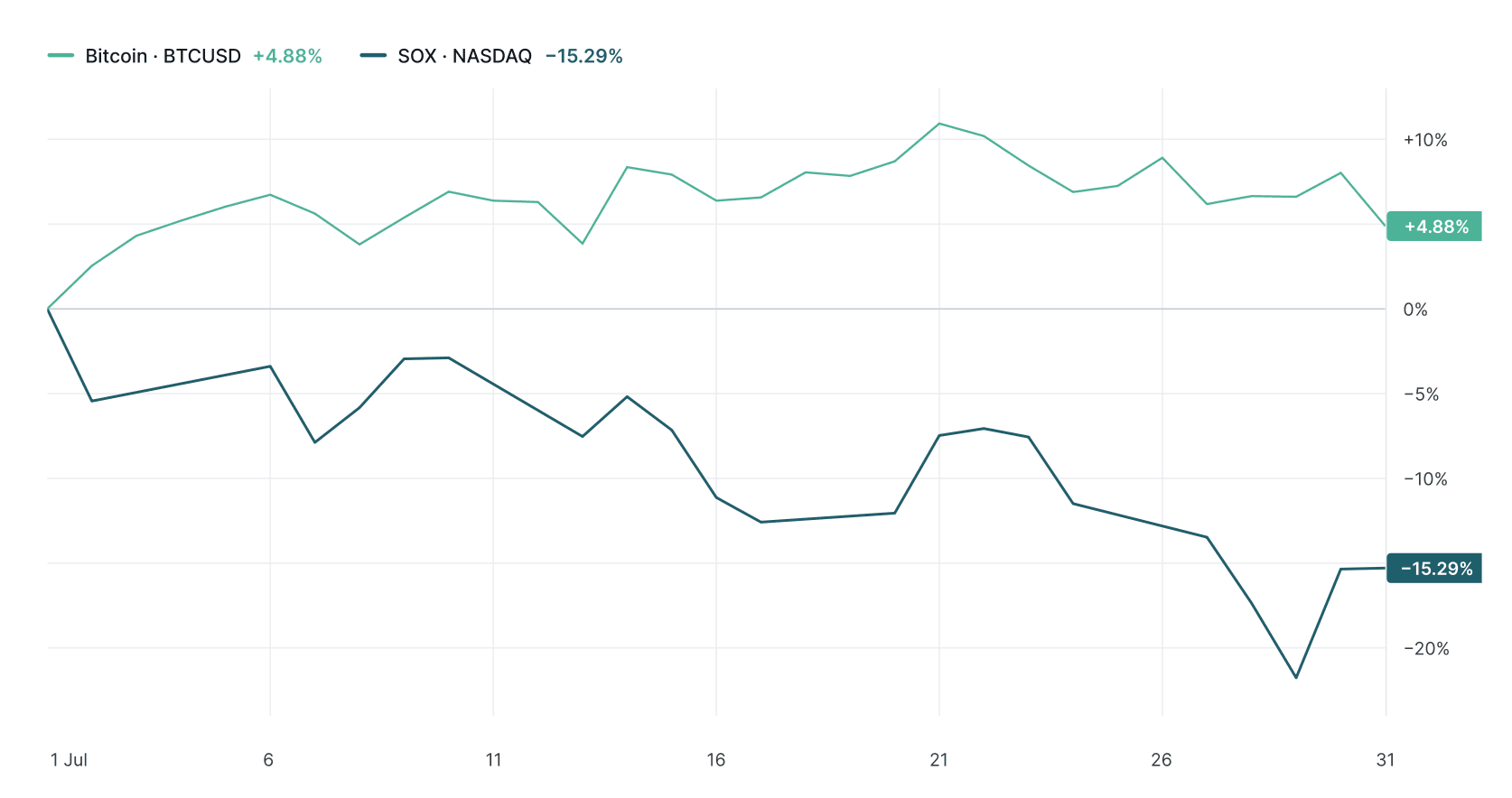
Digital assets began July where June left them, heavy, and finished the month as the best-performing major asset class. Bitcoin printed its low near $57,800 in the opening sessions, held above the 200-week moving average that had anchored the June decline, and recovered steadily to end the month around $64,000–65,000, up roughly 9%. That an asset class written off as risk-beta rallied through a month in which chip stocks crashed and oil broke $100 is the kind of relative-strength signal that deserves attention, though not overstatement: bitcoin entered the month already de-rated, and a bounce from oversold conditions is not yet a trend. Still, the character of the tape changed. Dips were bought rather than sold, and the market absorbed bad news, of which July supplied plenty, without making new lows.
Source: TradingView
Digital assets outperformed every major traditional asset class in July, rallying through the same month in which the semiconductor complex that led markets all year repriced violently.
More notable was the dispersion beneath the surface. Ethereum gained roughly 20%, from around $1,600 to $1,920, and the ETH/BTC ratio broke above the multi-month descending channel that had constrained it for the better part of a year, reaching its highest level since late April near 0.030. DeFi large caps such as Aave and Uniswap outperformed on the strongest days. We would resist any temptation to declare an altcoin season, one month does not make a rotation and bitcoin dominance remains high, but this is the first time in several quarters that relative strength has shown up outside bitcoin, and it is worth monitoring as a measure of where risk appetite within the asset class is forming.
The flow picture also turned. The ten-day, $2.73 billion outflow streak from the US spot ETFs that defined late June ended in the first week of July, replaced by $510 million of inflows over three sessions and, later in the month, a five-day run totalling roughly $727 million. This confirms the two-sided regime we described in May: ETF flows amplify whichever direction sentiment is already travelling, deepening drawdowns on the way down and, as July showed, accelerating recoveries on the way up. The ETF complex is now the marginal price-setter in both directions.
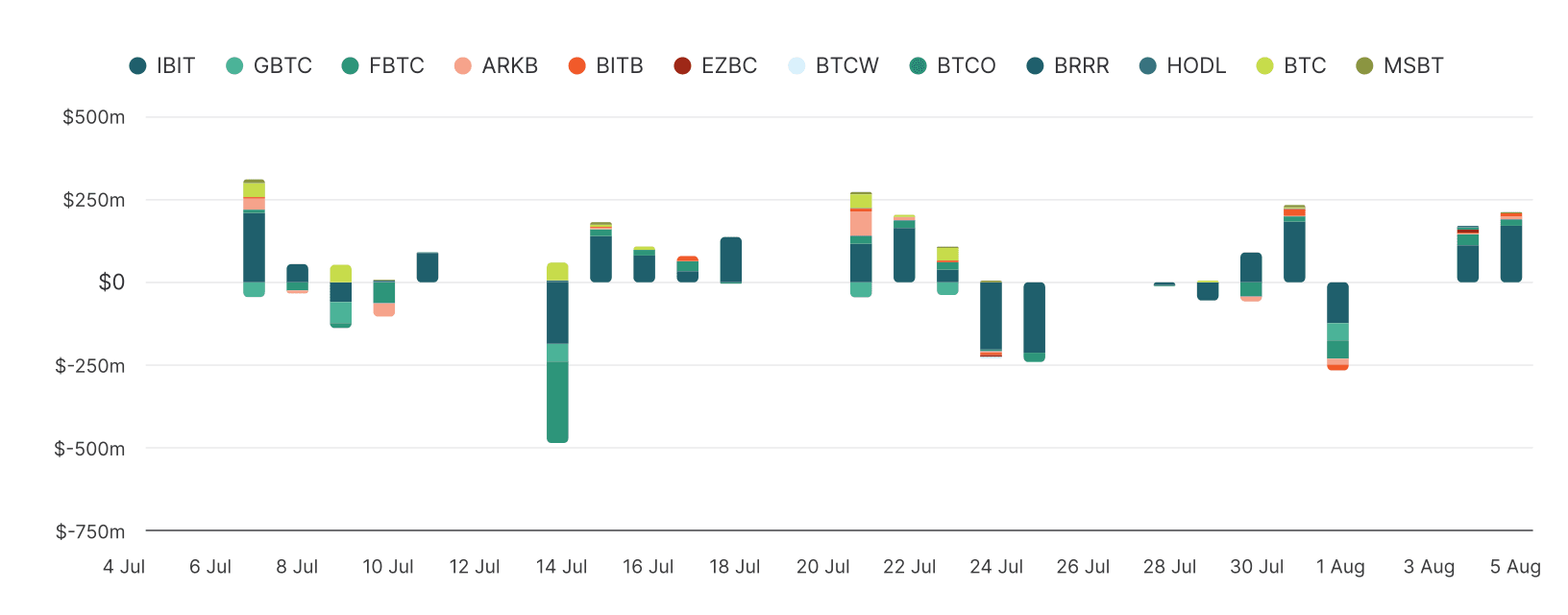
Source: The Block
After a record outflow streak spanning late June and early July, spot ETF flows turned positive and stayed two-sided through the recovery.
The most important development, however, was a test the market passed. Strategy sold 3,588 bitcoin for approximately $216 million between 29 June and 5 July to fund its preferred dividends, the largest disposal in its history, leaving holdings of roughly 843,775 bitcoin alongside a $2.55 billion dollar reserve under the Bitcoin Monetisation Programme formalised at quarter-end, which authorises up to $1.25 billion of sales. Last quarter we described the reflexive loop, forced selling begetting lower prices begetting more forced selling, as the clearest structural tail risk in the asset class. In July the most closely watched holder actually sold, at scale and in the open, and the loop did not engage: bitcoin absorbed the supply and finished the month higher. That does not retire the risk, the preferred obligations are perpetual and the model remains leveraged to the bitcoin price, but a feared scenario partially realised without cascade is a genuine structural positive. The market has now seen the monster, and it proved survivable.
Positioning data tell a consistent, and consistently cautious, story. DVOL, bitcoin’s implied-volatility index, spent the month near 37, close to multi-year lows, even as spot carved out a 15% range, the “illusion of calm” we have now noted for three consecutive letters. The one-month 25-delta put skew reached +9.5 points in late June, a level historically associated with softer forward returns. Towards the end of the month though shorter-dated skew compressed meaningfully as the recovery took hold. Perpetual funding flipped modestly positive, running roughly 0–8% annualised across venues against the negative prints of May and June. Taken together: positioning has turned cautiously long, but the options market is still paying up for downside protection. The complacency is thinner than it was, and that is a prerequisite for a sustained up-move.
Regulation was the month’s disappointment. The CLARITY Act remains stuck ahead of the Senate’s 10 August recess, the effective deadline for passage before the midterms; the ethics provisions that had held up negotiations reportedly won presidential sign-off on 21 July, but no floor vote is scheduled, and passage this year now looks increasingly unlikely. It is worth noting how well the market took this. A catalyst the industry spent months anticipating is quietly slipping, and digital assets nonetheless outperformed every major traditional asset class in July. Were the bill to pass after all, it would now arrive as a genuine upside surprise rather than a priced-in event. In Europe, MiCA showed its teeth within weeks of the 1 July deadline, with the stablecoin issuer StablR suspending minting and redemptions after acknowledging that its reserves no longer met the regulation’s 1:1 backing requirement. The institutionalisation theme, meanwhile, advanced regardless of price, as it has all year: tokenised real-world assets excluding stablecoins reached roughly $33.5 billion, nearly tripling year-on-year, the stablecoin market capitalisation sits near its all-time high around $320 billion, and tokenised equities remain the fastest-growing category following Nasdaq’s approval.

Source: TradingView
The ETH/BTC ratio broke above the descending channel that had constrained it for the better part of a year – an early, and so far tentative, sign of dispersion returning to the asset class.
July tested the complacency we had flagged in previous letters, and markets, on the whole, held up. The three risks we flagged at quarter-end, an oil market pricing a settlement that did not exist, an equity market resting on a single crowded theme, and a bitcoin treasury complex whose financing model runs in reverse, all triggered within four weeks, and none of them cascaded. Oil broke $100 and settled back; Korea crashed and rebounded sharply in the final session; Strategy sold and the market absorbed it. The question that matters for the second half is whether July demonstrated resilience or merely used it up: whether the system absorbed the stress, or we have felt the first tremor and the policy responses that arrested it have bought time rather than resolution.
For digital assets, the month’s relative strength poses its own question: early evidence of decoupling, or an oversold bounce from an already de-rated base? We lean toward the humbler reading, while acknowledging that the asset class did something in July it has not done for several quarters: it went up when everything else went down. The tentative revival in Ethereum and the first breadth signals beyond bitcoin are, on the same logic, encouraging rather than conclusive. It is far too early to call an altcoin revival, but for the first time in a while the early indications point toward one rather than away.
The biggest variable, though, is interest rates. A Federal Reserve that has abolished forward guidance, faces internal dissent in favour of hikes, and watches thirty-year yields at their highest since 2007 is the single greatest threat to the AI trade and to everything priced off it. Korea has just demonstrated what happens when peak expectations meet a rate shock in a concentrated market; the US version of that experiment, should the long end keep pushing or the Fed be forced to act, would run at far greater scale.
Into August, the watch list is well defined: the July CPI print and the speed at which $100 oil passes through it; whether the ten-day ceasefire proposal holds or the Red Sea escalation widens; whether Korea’s stabilisation survives the withdrawal of its policy support; whether the joint US–Japan yen intervention holds; the timing and reception of the Anthropic listing; and whether the CLARITY Act finds a floor vote before the recess closes the window.
Investment advisory and asset management services are provided by Lionsoul Global Advisors Ltd. (“Lionsoul Global Advisors”), an investment adviser organized in the British Virgin Islands and relying on the safe harbor under the Investment Business (Approved Managers) Regulations, Revised Edition, 2020, pending approval by the BVI Financial Services Commission for approval as an “Approved Manager.” Lionsoul Global Advisors does not and cannot provide any services to U.S. or U.S.-based clients.
Past performance is not indicative of future results, and there can be no assurance that the portfolio will achieve its investment objectives or that any investment strategy will be successful.
Certain statements contained herein constitute forward-looking statements, including statements regarding anticipated market conditions, portfolio positioning, and expected opportunity sets. Such statements involve known and unknown risks, uncertainties, and other factors that may cause actual results to differ materially from those expressed or implied. Forward-looking statements speak only as of the date made and are subject to change without notice.