
Insights
Digital Asset Market: July in Review
Insights
Digital Asset Market: July in Review


Dear Investors,
The month of July marked a continued uptrend across risk assets, including crypto. Bitcoin ended the month around USD 116.5k, up 8.1%. But unlike the previous three months — where Bitcoin dominated — the positive sentiment finally began to spill over into parts of the altcoin market. Ethereum, which celebrated its 10-year anniversary in July, surged 48.7% month- over-month — its strongest monthly performance since July 2022. Bitcoin dominance dropped by approximately 4%, reaching its lowest level since February.
These price gains were accompanied by a notable rise in spot volumes — an unusual development for the typically quiet summer months. Seven-day average exchange volumes climbed back to levels last seen in early March, while spot Bitcoin ETF AuM reached new all-time highs.
Derivatives markets echoed the optimism. Aggregate open interest in Bitcoin options hit a new record in July, surpassing the previous highs set in June. However, implied volatility — while picking up — remains historically low, signalling more selling than buying pressure. Short-dated options are skewed towards puts over calls, and the futures curve remains in contango, suggesting underlying bullish positioning, though far from euphoric.
On the regulatory front, July was particularly active. Most notably, the U.S. president signed the GENIUS Act into law, introducing a federal licensing regime for stablecoin issuers and providing much-needed clarity. In parallel, the House passed the CLARITY Act, aiming to delineate jurisdiction between the SEC and CFTC, and the Anti-CBDC Act, which prohibits the issuance of a U.S. central bank digital currency on privacy grounds. Adding to the momentum, the President’s Working Group on Digital Asset Markets released a 160-page policy report recommending sweeping reforms across securities law, banking, taxation, market structure, custody, and cybersecurity — an effort to reinforce U.S. leadership in digital finance. After years of regulatory overreach, the tone has clearly shifted, bolstering the image of the U.S. as a crypto-friendly jurisdiction.
Risk assets more broadly also performed well in July. The S&P 500 extended its post-April rebound, albeit at a slower pace, while European equities posted modest gains. Overall, July showcased the market’s apparent resilience — particularly in the U.S. — to rising political and economic uncertainty. While tensions around tariffs persist and the macro outlook has dimmed, markets appear — perhaps too complacently — to be brushing off these concerns for now.
Risk assets have shrugged off the tariff turmoil. While many countries have since renegotiated more favourable trade terms with the U.S. following the announcement of the “Liberation Day” tariffs, significant trade barriers remain in place. Yet markets have pressed higher, with the S&P 500 and other global indices repeatedly pushing to new all-time highs. Bond markets have also stabilised as investor anxiety eased. On the surface, this resilience may be viewed as a testament to the strength of the global economy — particularly in the U.S.
While that interpretation holds some weight, we believe a more nuanced perspective is warranted. There is indeed surprising strength in the U.S. economy, most notably among corporates. The second-quarter earnings season revealed strong performance across the financials, communication services, and tech sectors, with standout results from Apple, Meta, Microsoft, and major banks such as JPMorgan and Goldman Sachs. So far, two-thirds of S&P 500 companies have reported Q2 earnings, with 82% beating EPS estimates — well above the 5- and 10-year averages.
That said, signs of strain are emerging. More trade-exposed sectors such as materials and consumer staples have reported negative earnings growth. The latest U.S. GDP print — while beating headline expectations — was driven largely by a rebound effect and a drop in imports. Domestic demand, by contrast, rose at its slowest pace in two and a half years. Meanwhile, labour market data for May and June was sharply revised downward, pointing to a cooling jobs market. In Europe, the more export-sensitive Stoxx 600 index, is on track for no earnings growth year-over-year. In a note to clients, Deutsche Bank said they expect tariffs to cost European equities around 4% earnings growth this year.
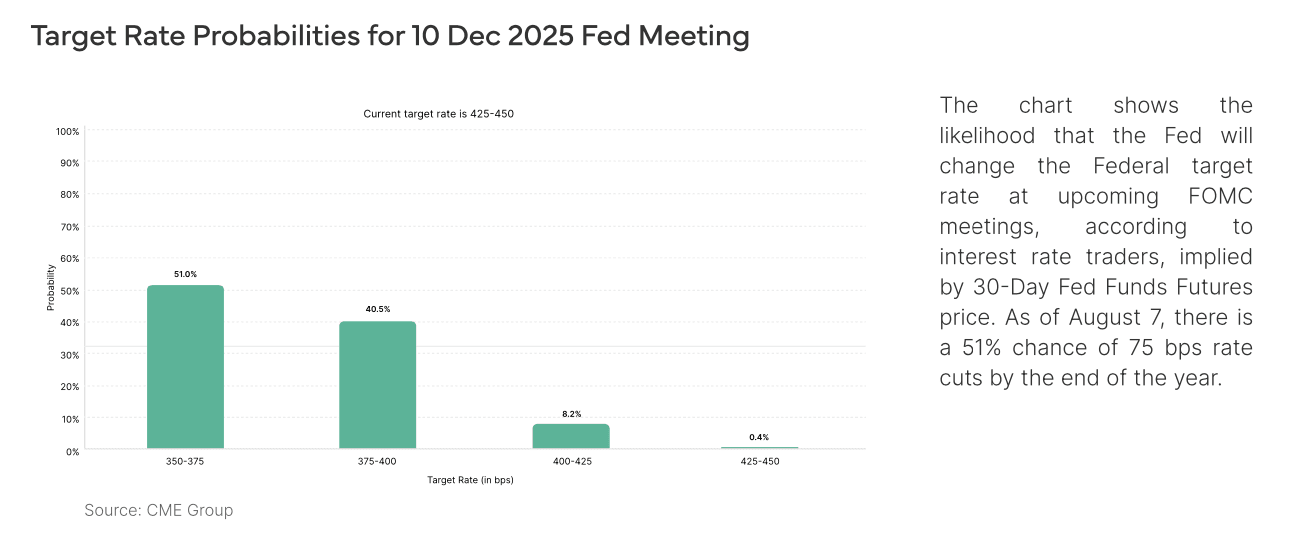
Amid growing economic uncertainty and unpredictable trade policy, the Fed held rates steady at its latest meeting. However, following a wave of weaker-than-expected macro data, market expectations have shifted towards a cut as early as the next FOMC meeting, with two to three cuts now priced in by year-end.
Looking ahead, the outlook for risk assets appears mixed. On one hand, large-cap tech — fueled by ongoing AI investment— may continue to drive index-level returns.
Market sentiment remains exuberant, with Microsoft and Nvidia both surpassing $4 trillion in market cap, and Figma’s IPO surging 250% on its debut — a confirmation of the buoyant mood. On the other hand, underlying macro headwinds — declining consumer spending, rising unemployment, and persistent trade uncertainty — suggest the risk of complacency may be growing. The S&P 500’s forward P/E ratio currently stands at 22.2, well above its 5-year average (19.9) and 10-year average (18.5). Unless there’s a meaningful improvement in the growth outlook or continued momentum in the AI narrative, a market correction may not be far off.
Following the strong Bitcoin-led rally post "Liberation Day," positive sentiment has finally started to spill over into parts of the altcoin market—most notably Ethereum. Celebrating its 10-year anniversary, Ethereum surged 48.7% in July alone and is now up more than 150% since the April lows.
What began as a small, idealistic project led by Canadian developer Vitalik Buterin has grown—against all odds—into what many consider the trust layer of the crypto ecosystem. Despite a rocky start marked by internal founder disputes, scalability concerns, frequent network congestion, and the high-profile DAO hack in 2016, Ethereum has evolved into the most robust and battle-tested layer-1 network in the industry.
Since launch, Ethereum has achieved:
While Ethereum has led this new leg of the rally, the broader altcoin market has only followed modestly. The recent drop in Bitcoin dominance can largely be attributed to Ethereum’s outperformance. Other altcoins, such as Solana, posted gains — but far less spectacular. Historically, market cycles tend to begin with Bitcoin, followed by Ethereum, and then trickle down to mid- and small-cap altcoins. If this pattern holds, we may now be entering the second phase of the cycle — potentially setting the stage for broader altcoin outperformance in the weeks ahead. It is also worth noting that, while Bitcoin recently reached new all-time highs, Ethereum, Solana, and other leading layer-1 tokens are still trading well below their 2021 peaks — suggesting there could still be considerable upside.
The derivatives market currently also paints an improving picture but not necessarily one of irrational exuberance. Funding rates for both Bitcoin and Ethereum are firmly in positive territory, though still below the euphoric levels seen in December. The same holds true for futures basis levels: positive, but below long-term averages.
On the options side, the Deribit DVOL Index — a 30-day implied volatility benchmark akin to the VIX — recently hit its lowest level since the index's inception in March 2021, even dipping below last month’s lows. This reflects a market that is not pricing in significant volatility, with skew favouring puts over calls on the short end — an indication of increased hedging demand relative to bullish speculation.
In DeFi, momentum continues to build. According to DeFiLlama, total value locked reached $83 billion in July — its highest level since January 2022 — driven by increased user activity, higher asset prices, and renewed interest in staking and lending protocols.
Regulatory tailwinds have also played a role. As previously noted, the CLARITY and GENIUS Acts passed in the U.S. have helped provide much-needed legal clarity. Adding to the positive sentiment, BitGo and Bullish — two major regulated players — have both filed for IPOs. Kraken is reportedly raising funds at a $15 billion valuation, likely paving the way for a public listing in 2026.
Lastly, the venture funding landscape has come back to life. July saw a significant rebound in crypto startup investments, with over $2.6 billion raised across 130+ rounds, according to PitchBook — making it one of the most active months for crypto VC activity since the 2022–23 correction. This uptick reflects renewed conviction in the long-term potential of Web3, DeFi, and crypto infrastructure.
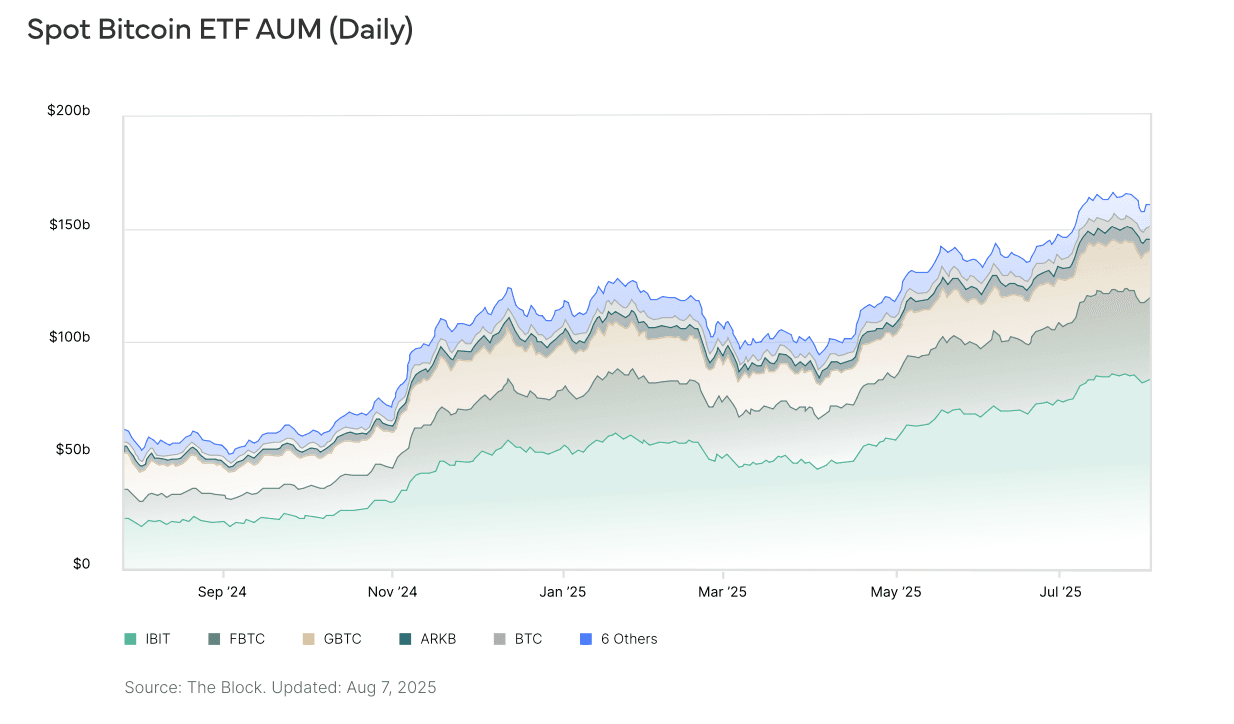
Fuelled by strong inflows and higher valuations, Bitcoin Spot ETFs reached record AuM in July.
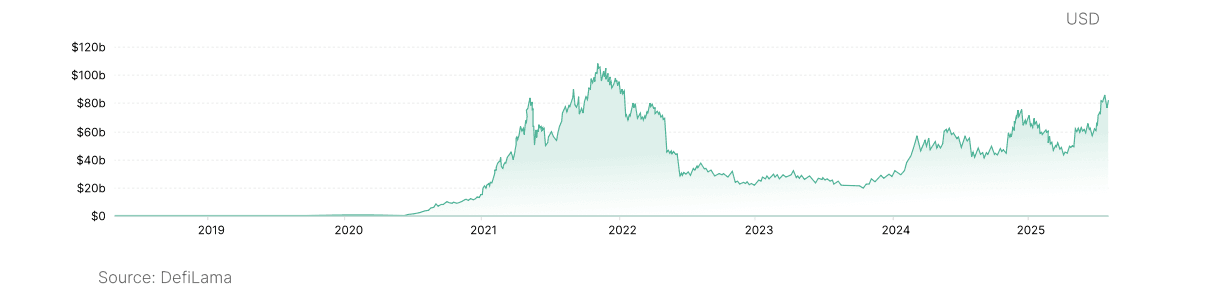
Total value locked in DeFi has reached its highest level since January 2022, an indication that the rally is broadening beyond Bitcoin.
July marked a continuation of the uptrend digital assets have experienced since April. In an encouraging sign of a broadening rally, positive sentiment has extended beyond Bitcoin, with Ethereum and several smaller tokens posting strong returns. Market activity has picked up across spot markets, derivatives, and DeFi protocols. We believe that a combination of positive price momentum, supportive regulatory developments, and the prospect of a more dovish monetary policy will likely continue to fuel this trend in the weeks ahead.
Investment advisory and asset management services are provided by Lionsoul Global Advisors LLC (“Lionsoul Global Advisors”), a U.S. investment adviser registered with the Texas State Securities Board (CRD #: 324883). Lionsoul Global Advisors is a member of the U.S. National Futures Association (NFA ID: 0553130). Information presented, displayed, or otherwise provided is for educational purposes only and should not be construed as investment, legal, or tax advice, or an offer to sell or a solicitation of an offer to buy any interests in a fund or other investment product. Access to the products and services of Lionsoul Global Advisors is subject to eligibility requirements and the definitive terms of documents between potential clients and Lionsoul Global Advisors, as they may be amended from time to time.